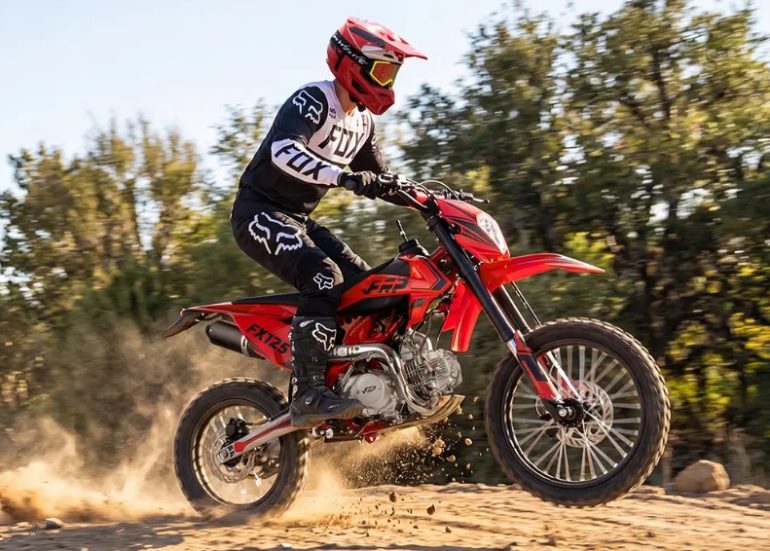
Moving from a small automatic bike to a dirt bike with a hand-operated clutch creates an awkward buying problem.
Many Japanese youth trail bikes have four gears but use an automatic clutch. They are useful for learning balance, throttle control and foot shifting, but they do not teach friction-zone control or coordinated clutch-and-throttle starts.
Affordable manual-clutch 125cc bikes solve that problem, but specifications, fit, warranty, and parts support vary widely. The right choice comes down to three questions:
- Does the bike fit the rider?
- Does it teach the skill the rider is ready to learn?
- Can the owner maintain it after the first season?
This comparison covers the Honda CRF110F, Yamaha TT-R110E, Kawasaki KLX110R L, SSR SR125 and FRP FX125 manual-clutch dirt bike.
The Short Answer
Choose the Honda CRF110F when easy operation, fuel injection and dealer support matter more than learning a clutch lever.
Choose the Yamaha TT-R110E for a similar low-seat, automatic-clutch four-speed experience.
Choose the Kawasaki KLX110R L when the rider fits its 28.7-inch seat and wants a manual clutch with Japanese dealer backing.
Choose the FRP FX125 when a true 125cc manual clutch and rider fit are both priorities. Its two factory wheel sizes suit shorter riders, taller teens and adults.
Choose the SSR SR125 when its 30-inch seat fits, kick starting is acceptable and the buyer prefers an established pit-bike brand.
First Decide What the Rider Needs to Learn
The Honda CRF110F has four selectable gears, but no clutch lever. The rider shifts with the left foot without managing the clutch or worrying about stalling.
The Yamaha TT-R110E works similarly. It teaches gear selection without adding clutch-lever control at the same time.
They do not teach:
- finding the clutch’s friction zone;
- coordinating throttle and clutch release;
- starting on a hill with a hand clutch;
- feathering the clutch at low speed;
- recovering from a near-stall.
If clutch control is the purpose of the next bike, this distinction matters more than displacement.
Fit Still Comes Before the Clutch
A technically correct bike can still be the wrong purchase if it does not fit.
New riders often struggle with starts, stops, low-speed turns, stalls and uneven ground. A rider who can reach the ground securely has more attention available for the clutch.
The rider should be able to steady the bike without sliding far off the seat and:
- pull the clutch lever without stretching;
- reach the shifter and rear brake naturally;
- turn the handlebars without locking the arms;
- stand on the foot pegs without feeling crowded;
- pick the bike up after a minor tip-over.
Seat height, wheel size and confidence are more useful than age alone.
Current Specifications at a Glance
| Model | Engine | Clutch | Seat height | Start | Published price |
|---|---|---|---|---|---|
| Honda CRF110F | 109cc air-cooled | 4-speed automatic clutch | 25.9 in | Electric + kick | $2,799 MSRP + destination |
| Yamaha TT-R110E | 110cc air-cooled | 4-speed automatic clutch | 26.4 in | Electric + kick | $2,449 MSRP |
| Kawasaki KLX110R L | 112cc air-cooled | 4-speed manual | 28.7 in | Electric | $3,199 MSRP + destination |
| FRP FX125 | 125cc Zongshen | 4-speed wet manual | 28.1 or 33.9 in | Electric + kick | From $799.99, free shipping |
| SSR SR125 | 124cc YX | 4-speed manual | 30 in | Kick | $1,359 MSRP + fees |
Honda CRF110F: Easy and Established
The CRF110F has a low 25.9-inch seat, fuel injection, electric start with backup kick, an automatic clutch, a throttle limiter and Honda’s dealer network.
It is a logical choice for a smaller or less confident rider who needs to focus on basic control before learning a hand clutch.
It teaches foot shifting, but not clutch-lever control, and may feel cramped for taller teenagers.
Choose the Honda when: the rider needs a low, approachable trail bike and clutch training is not yet the goal.
Yamaha TT-R110E: Similar Learning Priorities
The Yamaha has a 26.4-inch seat and an automatic clutch, allowing the rider to practise four-speed gear selection without using a hand lever.
Choose the Yamaha when: the rider needs an easy four-speed trail bike and Yamaha dealer access or brand preference makes it the more convenient purchase.
Kawasaki KLX110R L: Japanese Support With a Real Clutch
The KLX110R L adds a four-speed manual clutch, a 28.7-inch seat, electric start and access to Kawasaki dealers and parts.
Its seat fits many youth riders and shorter teens but may feel compact to a tall teen or adult. It also costs substantially more than most direct-to-consumer 125cc options.
Choose the Kawasaki when: the rider fits the bike, a real clutch is required and Japanese dealer support justifies the price.
Where the FRP FX125 Fits
The FX125 is not simply a cheaper version of the Honda or Kawasaki. Its role is different: it offers a real manual-clutch 125cc bike at a lower entry price while addressing two common weaknesses in the affordable category—limited size choice and unclear ownership support.
FRP offers the same engine in two factory configurations:
- 14-inch front and 12-inch rear wheels, with a 28.1-inch seat;
- 17-inch front and 14-inch rear wheels, with a 33.9-inch seat.
The smaller build gives shorter riders easier ground reach. The larger build gives taller teens and adults more legroom and clearance.
Both use the same listed Zongshen 125cc engine and four-speed wet manual clutch.
That structure separates two decisions:
- Which chassis height fits the rider?
- Is a 125cc manual engine appropriate for the rider’s experience?
A taller rider does not have to buy more engine simply to get more room. A shorter rider does not have to accept a tall seat just because they are ready for a clutch.
This is the clearest expression of FRP’s rider-matching approach: choose around the rider’s body and skill level, not displacement alone.
The FX125 Is Not Simply a Cheaper Japanese 110
The Japanese 110-class bikes prioritize easy operation, low seats, automatic clutches, dealer service and beginner confidence.
The Kawasaki KLX110R L adds a manual clutch while remaining compact and dealer-backed.
The FX125 prioritizes:
- a true 125cc manual-clutch experience;
- two substantially different seat heights;
- front and rear hydraulic disc brakes;
- a published 265-pound maximum load;
- electric start with kick backup;
- direct-to-customer value.
The smaller FX125 has a seat close to the KLX110R L. The larger version is intended for taller teens and adults.
Why Naming the Engine Matters
An engine brand does not guarantee reliability, but knowing the platform still helps.
FRP identifies the FX125 engine as a Zongshen 125cc four-stroke and publishes power, torque and maintenance specifications. SSR similarly identifies the SR125’s YX engine.
That gives owners a clearer starting point for service information, parts and troubleshooting.
The benefit is not that the name prevents problems. It is that the owner has more information when a problem needs to be solved.
What Happens After the Sale
A lever, cable, brake component or chain is not a major repair. But even a small repair can park the bike if the owner cannot identify the correct part.
FRP states that it provides a one-year limited warranty, replacement parts, setup guidance, manuals and direct owner support. The FRP warranty and owner support page matters more to long-term ownership than another horsepower claim.
This is not the same service model as a Honda or Kawasaki dealer network. FRP is primarily direct support.
Honda and Kawasaki owners usually start with a dealer. FRP owners start with the manufacturer’s support and parts system. Less-documented marketplace bikes may depend on the individual seller.
FRP should therefore be understood not as having a larger service network than Honda, but as offering a clearer ownership path than many similarly priced direct-to-consumer bikes.
SSR SR125: An Established Pit-Bike Alternative
SSR publishes the YX engine, output, 14″/12″ wheels, 30-inch seat, vehicle weight, front and rear disc brakes and four-speed manual transmission.
The base SR125 is kick-start only and has a shorter parts-only warranty than the FX125. SSR also sells separate big-wheel 125cc models, but moving to a larger bike means choosing a different model and price point.
Choose the SSR when: its 30-inch seat fits, kick starting is acceptable and the buyer prefers SSR’s established pit-bike range.
Choosing Honestly
Buy the Honda CRF110F when:
- the rider needs a low and approachable bike;
- fuel injection and easy starting matter;
- clutch training is not yet necessary;
- local dealer access is a priority.
Buy the Yamaha TT-R110E when:
- the rider needs an automatic-clutch four-speed;
- the 26.4-inch seat fits;
- Yamaha dealer access or brand preference matters.
Buy the Kawasaki KLX110R L when:
- a manual clutch is required;
- the rider fits a 28.7-inch seat;
- Japanese dealer support is worth the price;
- an adult-sized riding position is unnecessary.
Buy the FRP FX125 when:
- learning a hand-operated clutch is the point;
- the rider needs a 28.1-inch or 33.9-inch seat;
- a taller teen or adult needs more room;
- electric and kick starting are useful;
- hydraulic disc brakes front and rear are preferred;
- the buyer wants a named engine, published specifications and direct parts support at a lower entry price.
Buy the SSR SR125 when:
- a 30-inch seat is correct;
- the rider is ready for a manual clutch;
- kick starting is acceptable;
- the buyer values SSR’s pit-bike range.
Buy a lower-priced marketplace 125 when:
- upfront cost is the overriding constraint;
- the exact model can be verified;
- the seller can identify the engine;
- parts and warranty terms are confirmed before purchase.
Delivery and Assembly
Dealer-sold Japanese bikes and freight-shipped direct-to-customer bikes provide different purchase experiences.
A Honda, Yamaha or Kawasaki may arrive prepared through a dealer, although setup and dealer fees can raise the final price.
The FX125 ships by LTL freight with curbside delivery. The carrier contacts the buyer to schedule the appointment, and the buyer should plan for crate handling and final assembly.
Off-Road Use and Safety
Every bike in this comparison is intended for off-road use.
A new manual-clutch rider should use a properly fitted helmet, eye protection, gloves, over-the-ankle boots, long sleeves, riding pants and appropriate adult supervision.
Initial clutch practice should take place on flat, open ground away from traffic, steep slopes and obstacles.
Frequently Asked Questions
Is the Honda CRF110F a manual dirt bike?
It has four selectable gears but uses an automatic clutch and has no hand lever. It teaches foot shifting and gear selection, not clutch-lever control.
Which bikes have a real manual clutch?
The Kawasaki KLX110R L, FRP FX125 and SSR SR125. The Honda CRF110F and Yamaha TT-R110E use automatic clutch systems.
Is the FRP FX125 better than the Honda CRF110F?
The Honda better suits a smaller rider who needs easy operation and dealer support. The FX125 better suits a rider ready to learn a hand clutch, needing a taller option or wanting a 125cc manual at a lower purchase price.
Is the FX125 physically larger than the CRF110F?
The small-wheel FX125 has a 28.1-inch seat, compared with the Honda’s 25.9-inch seat. The large-wheel FX125 has a 33.9-inch seat for taller teens and adults.
Can a teenager ride the FX125?
Match the rider to the 28.1-inch or 33.9-inch seat by height, inseam, strength and experience.
Why does the FX125 have two wheel sizes?
They allow the rider to choose physical fit separately from engine displacement. Shorter riders can use the 14″/12″ version, while taller riders can choose the 17″/14″ version without moving to a larger engine.
Does FRP have the same support network as Honda or Kawasaki?
No. Honda and Kawasaki have dealer networks. FRP uses direct support with a published warranty, replacement parts, setup guidance and customer service.
Are these bikes street legal?
No. They are intended for private property and approved off-road riding areas. Check local rules before riding.
The Bottom Line
There is no single best first manual dirt bike because riders are not all taking the same next step.
The Honda CRF110F and Yamaha TT-R110E suit riders learning basic control and foot shifting without a clutch lever.
The Kawasaki KLX110R L is the premium compact option for learning a real clutch with Japanese dealer backing.
The SSR SR125 is an established manual pit-bike alternative with a published engine specification and mid-range seat height.
The FX125 occupies a different position. It combines a true manual clutch with two rider-fit options, a named Zongshen engine, front and rear hydraulic disc brakes, a published 265-pound load, a one-year warranty and direct parts support.
FRP’s product logic is visible in the choices it gives the rider:
- choose seat height and wheel size first;
- learn a real clutch when ready;
- use a documented engine platform;
- confirm parts and support after delivery.
Riders still comparing sizes and skill levels can view the FRP Moto gas dirt bike lineup
A first manual dirt bike should fit the rider, teach the intended skill and remain serviceable after the excitement of the first ride wears off.